
The Clemente Soto Vélez Cultural & Educational Center is a multidisciplinary arts organization and steward of a publicly owned historic cultural facility on Manhattan's Lower East Side. Founded in 1993 by Puerto Rican and Latinx artists, activists, and community leaders, The Clemente was established to preserve cultural space in a rapidly changing neighborhood while expanding opportunities for artistic creation, civic participation, and cultural exchange.
Today, The Clemente operates 100,000 square feet of shared cultural infrastructure that supports one of New York City's largest creative ecosystems. It serves simultaneously as an Arts Service Organization, Presenting Organization, Original Producer, and long-term home for artists, nonprofit organizations, and creative enterprises. Through affordable workspace, technical services, exhibitions, performances, residencies, commissions, and public programs, The Clemente strengthens artists, organizations, and neighborhoods while expanding participation in New York City's creative economy.
Rooted in Puerto Rican and Latinx cultural leadership, The Clemente views culture as a public resource and creative practice as essential civic life. It preserves space not only for artistic expression, but also for cultural memory, experimentation, dialogue, and collaboration across communities.

What we do
The Clemente develops and presents original artistic programs while creating the conditions that allow others to do the same. Each year, it commissions new work, produces exhibitions, multidisciplinary performances, citywide festivals, educational initiatives, and public humanities projects, while presenting the work of hundreds of artists and organizations.
Signature initiatives include HISTORIAS, a long-term platform documenting Latinx and immigrant contributions to New York City; the International Puppet Fringe Festival; BORIMIX; Día de Reyes; Open Studios; Building Community Through the Arts; and the Intra-Diasporic Curators Program.
Beyond its own programming, The Clemente provides affordable commercial workspace, rehearsal facilities, galleries, theaters, technical assistance, production support, and professional services that enable resident organizations, creative enterprises, and independent cultural producers to sustain and expand their work. The Clemente is also a co-founder and co-convener of the Latinx Arts Consortium of New York (LxNY), working alongside its steering committee and more than fifty member organizations to strengthen collaboration, advocacy, and resource sharing across the city's cultural sector.
BOARD
Veronica Relea
Partner, Baker Botts L.L.P.
Richard Morales
Director of Public Programs & Community Engagement, Socrates Sculpture Park
Annya Ramírez-Jímenez
Partner, Marvel Designs
Guido Hartray
Founding Partner, Marvel Designs
Urayoán Noel
Associate Professor of New York University, Author, Contributing Editor, NACLA Report on the Americas
Beatriz De La Torre
Chief Philanthropy Officer, Trinity Church NYC
Karina Aguillera Skvirsky
Multidisciplinary Artist
Ana Chireno
Vice President, The MirRam Group
OUR HISTORY
The Clemente was founded in 1993 through the leadership of Puerto Rican poet Ed Vega Yunqué, Uruguayan actor and director Nelson Landrieu, and Dominican actor Mateo Gómez, together with artists, community leaders, and neighborhood advocates committed to preserving a permanent home for culture on Manhattan's Lower East Side. At a time when demographic and economic change threatened longstanding artistic communities, they envisioned an institution where artistic practice, civic participation, and cultural exchange could remain rooted in public life.
The Center is named in honor of Clemente Soto Vélez (1905–1993), the Puerto Rican poet, journalist, educator, artistic mentor, and community organizer whose literary work and civic leadership left an enduring mark on New York's cultural life. Beyond his own writing, Soto Vélez nurtured generations of artists and cultural workers, influencing poets such as Tato Laviera, musicians including Roy Brown, and visual artists such as Pepón Osorio and Juan Sánchez. His commitment to community extended beyond the arts through organizing workers and founding the Hispanic Merchants Association, reflecting his belief that culture, education, labor, and civic life are deeply interconnected.
His legacy continues to guide the institution today. The Clemente understands culture as a process of collective authorship, where artistic creation, historical memory, neighborhood life, and civic participation continuously shape one another. Rooted in Puerto Rican and Latinx histories while embracing the polyphonic character of New York City, the Center creates space where multiple languages, artistic traditions, disciplines, and diasporic experiences meet, challenge one another, and generate new forms of public culture.

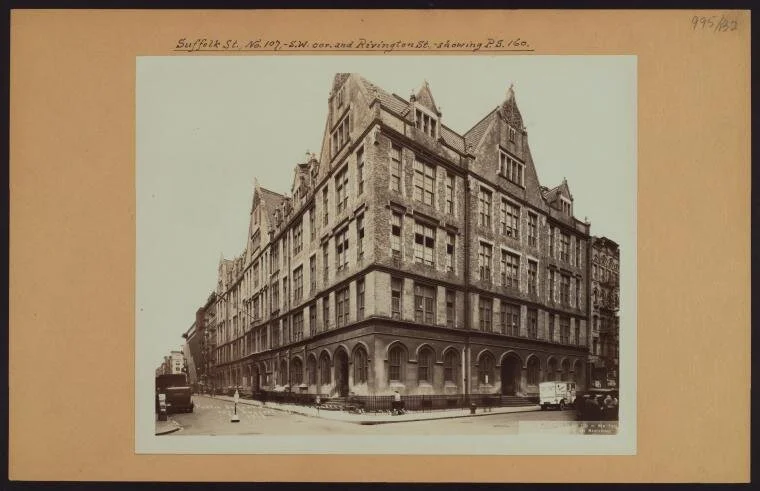


Formerly known as P.S. 160, erected in 1897-1898 in the collegiate neo-gothic or Dutch neo-gothic style.

Designed as infrastructure for public education,
it now serves as infrastructure for public culture.
The Clemente occupies the former Public School 160, a City-owned landmark completed in 1897 and designed by Charles B. J. Snyder, one of New York City's most influential public school architects. As Superintendent of School Buildings, Snyder transformed the design of urban schools by championing light, ventilation, fire safety, and flexible learning environments. He believed schools were civic monuments that could improve society through thoughtful public design. That philosophy remains embedded in the building today.
One of its most distinctive architectural features is the fourth-floor Cenacle, an assembly space designed with movable classroom walls that allowed students to gather for larger civic and educational events. Although those partitions were later replaced with permanent walls, traces of the original tracks remain visible in several studio ceilings, preserving a physical record of the building's educational past.
Following a fire in the 1970s, the school was vacated until Solidaridad Humana, a community-based educational organization, reopened the building in 1981 to serve Spanish-speaking immigrants. In 1993, it entered a new chapter as the home of The Clemente, continuing its public mission through arts, culture, and community.
Today, The Clemente stewards this 100,000-square-foot public cultural asset as one of New York City's largest shared cultural infrastructure organizations. The building houses four performance venues, two galleries, exhibition and project spaces, rehearsal facilities, artist studios, classrooms, organizational headquarters, and public gathering spaces. Designed as infrastructure for public education, it now serves as infrastructure for public culture, supporting artists, nonprofit organizations, creative enterprises, and independent cultural producers while enabling performances, exhibitions, festivals, residencies, education programs, and community events throughout the year.
Supported by more than $13 million in capital investment from the New York City Department of Cultural Affairs, the building is undergoing a major rehabilitation that will reopen in fall 2026 with full ADA accessibility, renewed building systems, and expanded public access. Alongside this City-led investment, The Clemente continues to undertake additional improvements that strengthen the historic facility's long-term role as a shared cultural resource, ensuring it remains a place where artists, organizations, and communities can create, gather, and contribute to New York City's civic and cultural life for generations to come.
Clemente SOTO VéleZ
Clemente Soto Vélez (1905-1993) was a poet, journalist and activist who mentored generations of Latino artists in Puerto Rico and New York City. He left a rich legacy that contributed to the cultural, social and economic life of Puerto Ricans in New York City and Latinos everywhere. Clemente founded literary and community organisations including the Puerto Rican Merchants Association. His life and work demonstrate his belief in self-sufficiency and community empowerment. Clemente Soto Vélez remains one of the most prominent of Puerto Rico’s poets, writing in the tradition of Neruda with powerful, passionate, socially visionary and surrealist vision. A sample of his work can be found in The Blood That Keeps Singing, where “the English-speaking reader can discover at last this major writer whose poetry and passionate social vision are inseparable, a man from whom the poet must be ‘light transformed into humanity.'” —MultiCultural Review

"Clemente Soto Velez" By Alfredo "Freddy" Hernández, 1996.


"Klemente" By Miguel Trelles, 2010.
I met him
living
like an h incarcerated in the honey of his bees,
but the bars of honey were bittersweet,
and because
he lost himself
in love with liberation,
and because he did not abandon
his love nor she her lover,
the earth for him is a hurricane of persecuted stars,
since liberation cannot
love anyone
except whoever loves
the earth, with its sun and sky.
from The Wooden Horse,
translated by Martín Espada and Camilo Pérez Bustillo.
FUNDERS
The Clemente's programs are generously supported in part by public funds from the New York City Department of Cultural Affairs, in partnership with the City Council, City Councilmember Christopher Marte, the New York State Council on the Arts with the support of Governor Kathy Hochul and the New York State Legislature; by the Robert Rauschenberg Foundation, Mellon Foundation, Ford Foundation, Rockefeller Brothers Fund, Lilly Endowment, Teiger Foundation, Howard Gilman Foundation, Claire and Theodore Morse Foundation, The Mosaic Fund, The MidAtlantic Arts Foundation, Booth Ferris Foundation, and the Henry Luce Foundation, the Willem de Kooning Foundation, and Teiger Foundation through the Coalition of Small Arts-New York.