
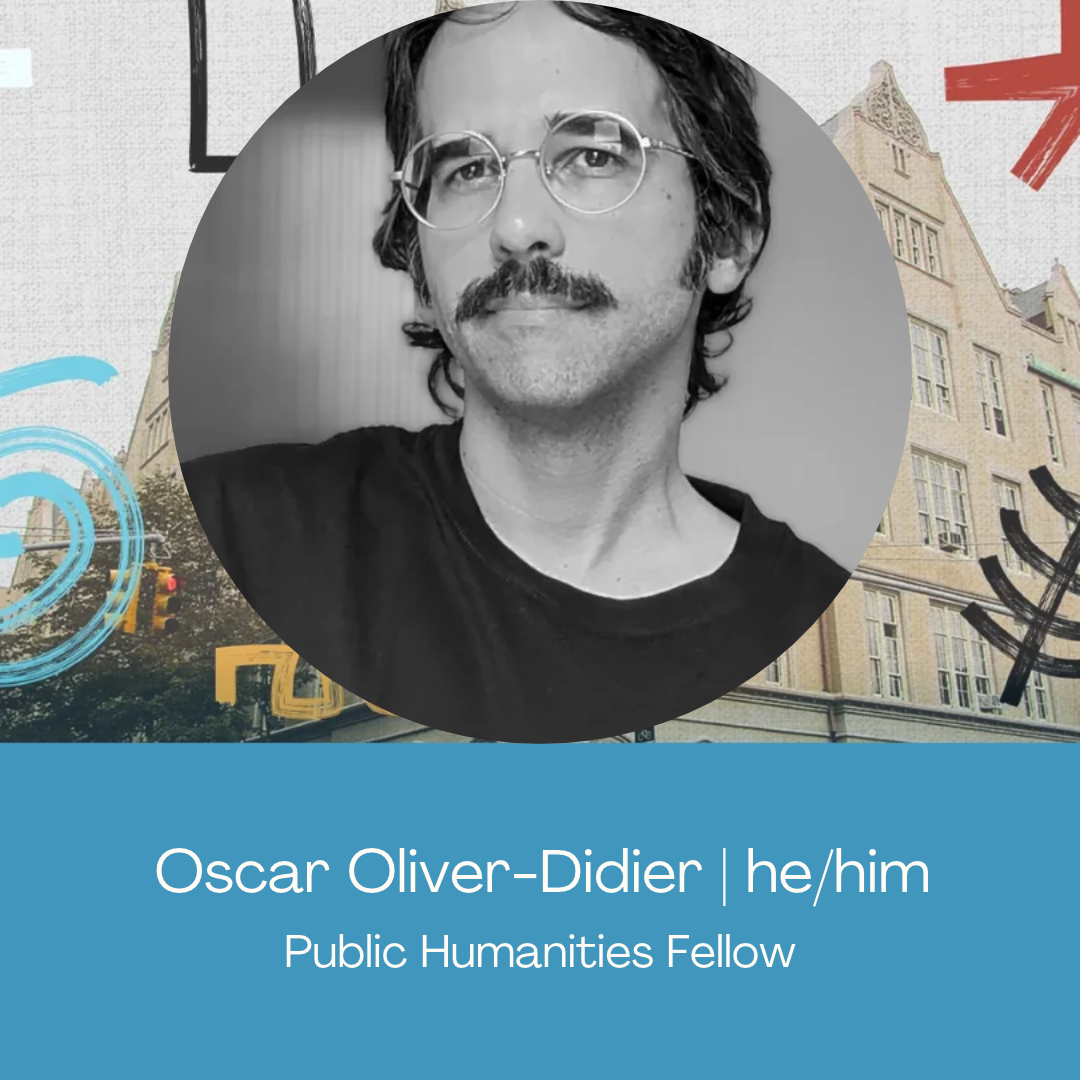
Born and raised in Puerto Rico, Oscar Oliver-Didier is an urban designer and critical urban studies scholar whose work examines how class and race materialize through propertied urban development. He is a PhD candidate in American Studies in the Department of Social and Cultural Analysis at New York University, where his dissertation traces the interdependence between urban property and policing. He currently serves as Head of the Built Environment track in the Visual Arts Program at Fordham University.
His current research, Policing Revitalization: Crime Prevention as Urban Life, traces how late-twentieth-century urban policy reframed the visible signs of poverty and disorder as financial risks, embedding crime control directly within the institutions and practices of neighborhood redevelopment. He has previously researched on the histories of public housing in Puerto Rico, the place-based politics of language in the South Bronx, and the spatial dimensions of urban protests. He has taught at the Graduate School of Architecture, Planning and Preservation at Columbia University, Parsons School of Design at The New School, and the School of Architecture at the Polytechnic University of Puerto Rico (PUPR).
Housed at the Clemente, Oliver-Didier is a founding member of the Shape of Cities to Come Institute (SCCI), a New York-based platform that brings together urban organizers, designers, scholars, and movement builders. He previously served as the Lead Urban Designer for the borough of the Bronx at the NYC Department of City Planning. In this role the city awarded him the Michael Weil Award for Urban Design, a recognition of excellence in the pursuit of urban design in the public sector. He was also director of the research collective CIUDADLAB; the Laboratory for Housing, Planning and Urban Studies at the PUPR; and was an Auxiliary Adviser on urbanism to the Governor of Puerto Rico. Oliver-Didier has published articles in Housing Theory and Society, Truthout, Urban Omnibus, CounterPunch, Revista Cruce, Planning Perspectives, and a chapter included in The Routledge Handbook of Henri Lefebvre, The City and Urban Society. He has edited multiple journals such as ENTORNO, Polimorfo, and Planning Perspectives. He lives in the South Bronx.